Thursday, October 8, 2009
history of Iran
The history of Iran is very deep. History of Iran started in the prehistoric period beginning with the earliest evidence of man on the Iranian Plateau and ending roughly at the start of the 1st millennium BCE. Then there is the proto-historic period covering approximately the first half of the 1st millennium BC. The third period is when Iran entered the full light of written history. The civilization of Elam, centered off the plateau in lowland Khuzestan, is an exception, for written history began there as early as it did in neighboring Mesopotamia.

culture of Iran
The culture of Iran goes back quite some time. Iran is located in southwestern Asia, largely on a high plateau situated between the Caspian Sea to the north and the Persian Gulf and the Gulf of Oman to the south. Its neighbors are, on the north, Azerbaijan, Armenia, and Turkmenistan; on the east, Pakistan and Afghanistan; and on the west Turkey and Iraq.
The terms "Iran" as the designation for the civilization, and "Iranian" as the name for the inhabitants occupying the large plateau located between the Caspian Sea and the Persian Gulf have been in continual use for more than twenty-five hundred years.
The Iranian nation is one of the oldest continuous civilizations in the world. Upper Paleolithic and Mesolithic populations occupied caves in the Zagros and Elburz mountains. The earliest civilizations in the region descended from the Zagros foothills, where they developed agriculture and animal husbandry, and established the first urban cultures in the Tigris-Euphrates basin in present day Iraq.
Iran has been somewhat blessed by an absence of specific ethnic conflict. This is noteworthy, given the large number of ethnic groups living within its borders, both today and in the past. It is safe to conclude that the general Iranian population neither persecutes ethnic minorities, nor openly discriminates against them.
The terms "Iran" as the designation for the civilization, and "Iranian" as the name for the inhabitants occupying the large plateau located between the Caspian Sea and the Persian Gulf have been in continual use for more than twenty-five hundred years.
The Iranian nation is one of the oldest continuous civilizations in the world. Upper Paleolithic and Mesolithic populations occupied caves in the Zagros and Elburz mountains. The earliest civilizations in the region descended from the Zagros foothills, where they developed agriculture and animal husbandry, and established the first urban cultures in the Tigris-Euphrates basin in present day Iraq.
Iran has been somewhat blessed by an absence of specific ethnic conflict. This is noteworthy, given the large number of ethnic groups living within its borders, both today and in the past. It is safe to conclude that the general Iranian population neither persecutes ethnic minorities, nor openly discriminates against them.
Wednesday, October 7, 2009
Perspolis

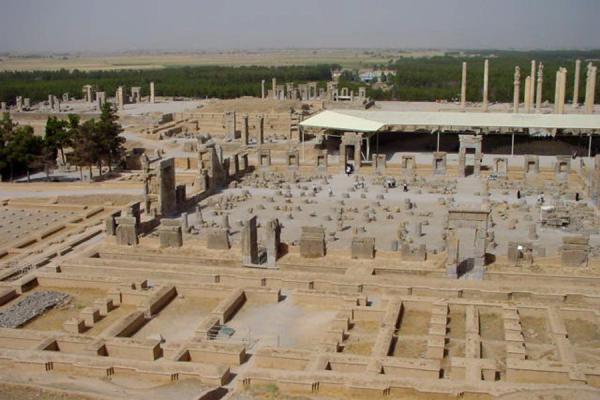
The columns of the Apadana of Persepolis
Persepolis was one of the ancient capitals of Persia, first established by Darius I in the 6th century BC. It's ruins lie 35 miles north-east of the city of Shiraz. Persepolis was constructed between 518 and 516 BC and it was continued in the 5th century by Darius's successor Xerxes I and Artaxerxes I. It is now know as the throne of Jamshid.
Persepolis was used as a place of celebrations under the Persian empire at its prime celebrations such as the new year were held there.
The aparthda was the largest building in Persipolis. It is estimated to hold an average of 10,000 people. The roof was supported multiple columns 13 in which still stand today.
On the stairs of this building are depictions of ceremonies that took place there. For example when kings of conquered nations brought gifts to their king.
Beyond the Apadana where the Palaces of Darius and Xerxes. Darius' palace was the Tachara. Stone stairways had carvings of slaves with animals and food for serving the king. The doorways were carved as well. The king fighting lions, servants bringing towels and ointments to the king, and attendants shielding the king with umbrellas and flywhisks where all represented on these walls. Some of which still stand today. Xerxes palace was much larger then Darius' it stood almost twice the size of his, but the decorations were similar.
The second largest building in Persepolis was the Throne Hall. In the Throne Hall the king received nobles, dignitaries, and received tributes. The treasury was next to the Throne Hall it stood as an armory to store gifts for the emperor on the New Year from selective nations.
Two centuries after being created Persepolis was destroyed. Alexander of Macedonia put it in flames. It took an extreme amount of work to proceed with all of the treasure that was inside of it.
After being abandoned, it was eventually rediscovered in 1620. It was visited for a few hundred years before it was further examined.
Women of Iran
Women's rights in Iran have always been an extremely sensitive issue. Even though women's rights have changed over the years, they have never been equivalent to the rights of men in Iran. This poses a threat on Iran, because women possess very few options when it comes to professions, marriage and other aspects of society. Most believe that equal treatment for men and women is a fundamental principal of international human rights standards. Yet, in Iran, discriminatory practices against women are not only prevalent and condoned, but also required by the government.
There have been strides to change this culture. In 1937 women were accepted into Iranian universities, in 1963 they were given the right to vote for their leaders, some women were even elected to be leaders in their communities. In 1979 these rights came to an abrupt halt when the Islamic Republic was established. Even though the government put tighter restrictions on women they still continued in their education. This shows that the women of Iran are persevering to gain the rights that they deserve.
No matter how hard women try to break free of their boundaries and restrictions the law can put them in their place. A women's testimony in court is half of that of a man, and a women's right to inheritance is also half of men's. These are not the only way the law keeps women down. The women of Iran's effort to fight back are ambled because of their religion. Also strict laws by the government make it hard to proceed in gaining any rights.
One day the women of Iran may reach this goal because of their attitude. They have a significantly better chance to do so then any other country in the middle east they have different attitudes they understand that their rights are being suppressed and that they, as human beings, deserve better. Progressions have been make the percentage of all Iranian women who are active in the economy has doubled from 1986 to 2000.
There have been strides to change this culture. In 1937 women were accepted into Iranian universities, in 1963 they were given the right to vote for their leaders, some women were even elected to be leaders in their communities. In 1979 these rights came to an abrupt halt when the Islamic Republic was established. Even though the government put tighter restrictions on women they still continued in their education. This shows that the women of Iran are persevering to gain the rights that they deserve.
No matter how hard women try to break free of their boundaries and restrictions the law can put them in their place. A women's testimony in court is half of that of a man, and a women's right to inheritance is also half of men's. These are not the only way the law keeps women down. The women of Iran's effort to fight back are ambled because of their religion. Also strict laws by the government make it hard to proceed in gaining any rights.
One day the women of Iran may reach this goal because of their attitude. They have a significantly better chance to do so then any other country in the middle east they have different attitudes they understand that their rights are being suppressed and that they, as human beings, deserve better. Progressions have been make the percentage of all Iranian women who are active in the economy has doubled from 1986 to 2000.
Current Iran Events: Have other countries offered Iran Nuclear Fuel?
Irans President, Mahmoud Ahmadinejad said that some other countries have offered to provide Iran with uranium enriched to 20% to use as nuclear reactor fuel. Iran has always insisted on its right to carry out its own enrichment of uranium for a nuclear programme which it says is for purely peaceful purposes, mainly to generate electricity to power its towns and cities. It denies Western suspicions its real aim is to build an atomic/ nuclear bomb, which would require uranium enriched to around 90 percent."There have been some proposals by individual countries and groups of countries. We are ready to hold talks with anyone interested. Our experts will soon start talks with those sellers," Ahmadinejad said.He said Iran could also buy nuclear fuel from the United States, its old enemy. "We want to buy fuel. We can buy it from anywhere and America can be a seller," ISNA news agency quoted him as saying.Uranium enrichment is at the heart of a long standoff between Iran and the West, which took a new twist last month when Tehran disclosed the existence of a previously secret underground enrichment plant near the holy Shi'ite city of Qom.Diplomats say it did so after learning Western intelligence services had discovered the site.Russia stepped into the debate on Wednesday, urging countries not to jump to hasty conclusions about the newly revealed plant and saying Iran was showing signs of cooperation with inspectors.Russia's Foreign Ministry complained of media speculation surrounding activities at the site. "We are convinced that hasty conclusions on this score will not benefit the objective assessment of the situation," it said in a statement.
A French outlook on the Iranian Revolution of 1979
Take a look at the videos clips and ignore the French man in the background.
The Iranian Revolution of 1979

The Iranian Revolution of 1979 was ignited by a pro-Khomeini demonstration in Qum in January 1978. Police stepped in to control the demonstration and in a matter of minutes it turned into a riot, about 70 people were killed before calm was restored. Khomeini, from his exile in Iraq, called upon his followers to commemorate the victims on the 40th day after their deaths, in accordance with Iranian mourning customs. In February they held services at mosques throughout the country, and demonstrations in Tabrīz exploded into riots during which more people were killed. Thus began a cycle of nationwide mourning services every 40 days, most of which turned violent and resulted in more wounded and fatalities. By late summer, when it became clear that the government was losing control of the streets, the shah imposed martial law on 11 cities as well as Tehrān. This move only escalated tensions. Employees in different industries and offices began striking to protest martial law, and within six weeks a general strike had paralyzed the economy, including the oil sector which is a vital part of their economy and government. By October the strikes/riots and demonstrations were becoming a unified revolutionary movement. Protected by his exile in Iraq, Khomeini continued to denounce the corruption and injustices of the shah's regime, as well as its dependence on the United States. His sermons were recorded, duplicated on endless amounts of cassette tapes, and smuggled into Iran. The tapes appealed equally to religious Iranians and members of the secular middle class. Alarmed by Khomeini’s growing influence, the shah persuaded the Iraqi government to expel him. Khomeini immediately found asylum in France, where access to the international media made it even easier for him to communicate with supporters in Iran. In November the shah realized that the army could not indefinitely contain the mass movement, and he began making plans for his departure from Iran. He left the country in mid-January 1979. Two weeks later, Khomeini returned to Iran in triumph after more than 14 years in exile. On February 11, 1979, the royalist government was overthrown, and in a referendum on April 1 Iranians voted overwhelmingly to establish an Islamic republic.
The Nation Of Islam Part I

Upon the Master's departure in 1934, the Honorable Elijah Muhammad labored tirelessly to bring life to his mentally and spiritually dead people until his return to the Master in 1975. The Honorable Elijah Muhammad identified the Master as being the answer to the one that the world had been expecting for the past 2,000 years under the names Messiah, the second coming of Jesus, the Christ, Jehovah, God, and the Son of Man. When the Honorable Elijah Muhammad asked Him to identify Himself He replied that He was the Mahdi. He signed His name in 1933 as Master Wallace Fard Muhammad to express the meaning of One Who had come in the Early Morning Dawn of the New Millennium to lay the base for a New World Order of Peace and Righteousness on the foundation of Truth and Justice; to put down tyrants and to change the world into a Heaven on Earth.
The Nation Of Islam Part II

On July the Fourth, the day of America's Independence celebration, He announced the beginning of His mission which was to restore and to resurrect His lost and found people, who were identified as the original members of the Tribe of Shabazz from the Lost Nation of Asia. The lost people of the original nation of African descent, were captured, exploited, and dehumanized to serve as servitude slaves of America for over three centuries. His mission was to teach the downtrodden and defenseless Black people a thorough Knowledge of God and of themselves, and to put them on the road to Self-Independence with a superior culture and higher civilization than they had previously experienced."
The Shah Part I
The Shah of Iran has ran away from the country following months of increasingly violent protests against his regime.
Shah Mohammed Reza Pahlevi and his spouse, Empress Farah, left Tehran and flew to Aswan in Egypt.
The couple's three youngest children were flown to the United States yesterday.
Official reports say the Shah has left for a "vacation" and medical treatment. In fact, he was asked to leave by the man he appointed prime minister earlier this month.
Over the past few months, there have been an increasing number of violent clashes between security forces and anti-Shah demonstrators.
Opposition to the Shah has become united behind the Muslim traditionalist movement led by Iran's main spiritual leader, Ayatollah Ruholla Khomeini, from exile in France.
Shah Mohammed Reza Pahlevi and his spouse, Empress Farah, left Tehran and flew to Aswan in Egypt.
The couple's three youngest children were flown to the United States yesterday.
Official reports say the Shah has left for a "vacation" and medical treatment. In fact, he was asked to leave by the man he appointed prime minister earlier this month.
Over the past few months, there have been an increasing number of violent clashes between security forces and anti-Shah demonstrators.
Opposition to the Shah has become united behind the Muslim traditionalist movement led by Iran's main spiritual leader, Ayatollah Ruholla Khomeini, from exile in France.
The Shah Part II

The Shah of Iran (1925–41), born in Savad Kouh, Mazandern Province. Pahlavi entered the Iranian army as a youth, and in 1921 was commander of a cossack force. A large part of the country was then controlled by Soviet troops whom Pahlavi expelled. In a coup d'état he established a new government in which he was minister of war and commander in chief of the armed forces. In 1923 he became premier, and two years later, when the Majlis, or National Assembly, deposed the reigning ruler, Ahmad Shah (1898–1930), Pahlavi was elected in his stead. His reign was notable for the introduction of Western customs and for his attempts to improve the transportation system and the financial structure of the country. In 1941, during World War II, when Riza Shah began to lean toward the Axis powers, Great Britain and the USSR occupied Iran and compelled him to abdicate in favor of his son, Muhammad Riza Pahlavi.
Subscribe to:
Comments (Atom)